Onset
The whole story

Update

Five working enzymes, and a robot taught cornhole by video

Google's launch post puts lab and physical results alongside the benchmarks. All of them are company-reported, without published data.

The part of Google's launch that spread fastest today was not a benchmark. Google says its scientists worked with Gemini 4 Argon to design serine esterases, enzymes that cut ester bonds, and that "in a matter of hours" the model assembled the data, tuned models and applied filters to reach "a final set of five novel designs." Lab testing, Google says, "confirmed robust catalytic activity across these designs".

That is a real experimental step: molecules were made and tested, not merely predicted. It is also, so far, a sentence in a blog post. Google published no reaction rates, no structures and no paper. The target molecule, 4-methylumbelliferyl acetate, glows under UV once its ester bond is broken, which is the standard readout in this field. The 2024 Baker lab work on designed serine hydrolases used the same substrate and reported its best designs were still "orders of magnitude slower than native hydrolases". "Robust catalytic activity" with no number attached cannot be placed against that. What Google is claiming is speed and a hit rate, not better enzymes.

Google makes a similar speed claim in robotics. It says Argon watched raw video of a person playing cornhole, mapped the space, wrote its own simulation code, and that Apptronik's Apollo humanoid then "sank seven consecutive shots" in a real trial, a pipeline it says compresses "weeks of manual simulation modeling into a few hours". On ERQA, a test of physical and spatial reasoning, Google says Argon scores 87% using pure reasoning, "outperforming every other frontier model" in the comparison it published. Seven throws is a demonstration, not a success rate.

The post also adds internal numbers Google had not given before: more than 100,000 Google employees use Argon monthly through an internal version of Antigravity, and over four weeks agentic code submissions rose 35% while post-submission rollbacks fell about 30%. Google is offering 10,000 scientists free access to Antigravity's highest tier for six months. Meanwhile VentureBeat notes a Business Insider report from October 10 that Googlers are already testing internal successors codenamed Barium and Carbon.

The pattern holds across the whole launch: specific, checkable-sounding claims, nearly all measured by Google. The enzymes are the most interesting of them because the work left the computer, and the most frustrating, because the data that would let anyone else judge it has not been released.
@GoogleDeepMind · Watch on 𝕏
More from this story

Update

Argon is out for paying users, and its half-price deal ends November 30

Google has opened Gemini 4 Argon to paid API customers and Pro and Ultra subscribers worldwide, and the launch discount that made it look cheap now has an end date.

Gemini 4 Argon is now available worldwide, but only to people who pay Google. Developers can use it through the paid Gemini API. Google AI Pro ($20 a month) and Ultra subscribers get it in the Gemini app and in AI Mode in Search. Antigravity, Google's coding-agent tool, is limited to Ultra subscribers. Google hasn't said whether free users or the cheaper Plus plan will get Argon.

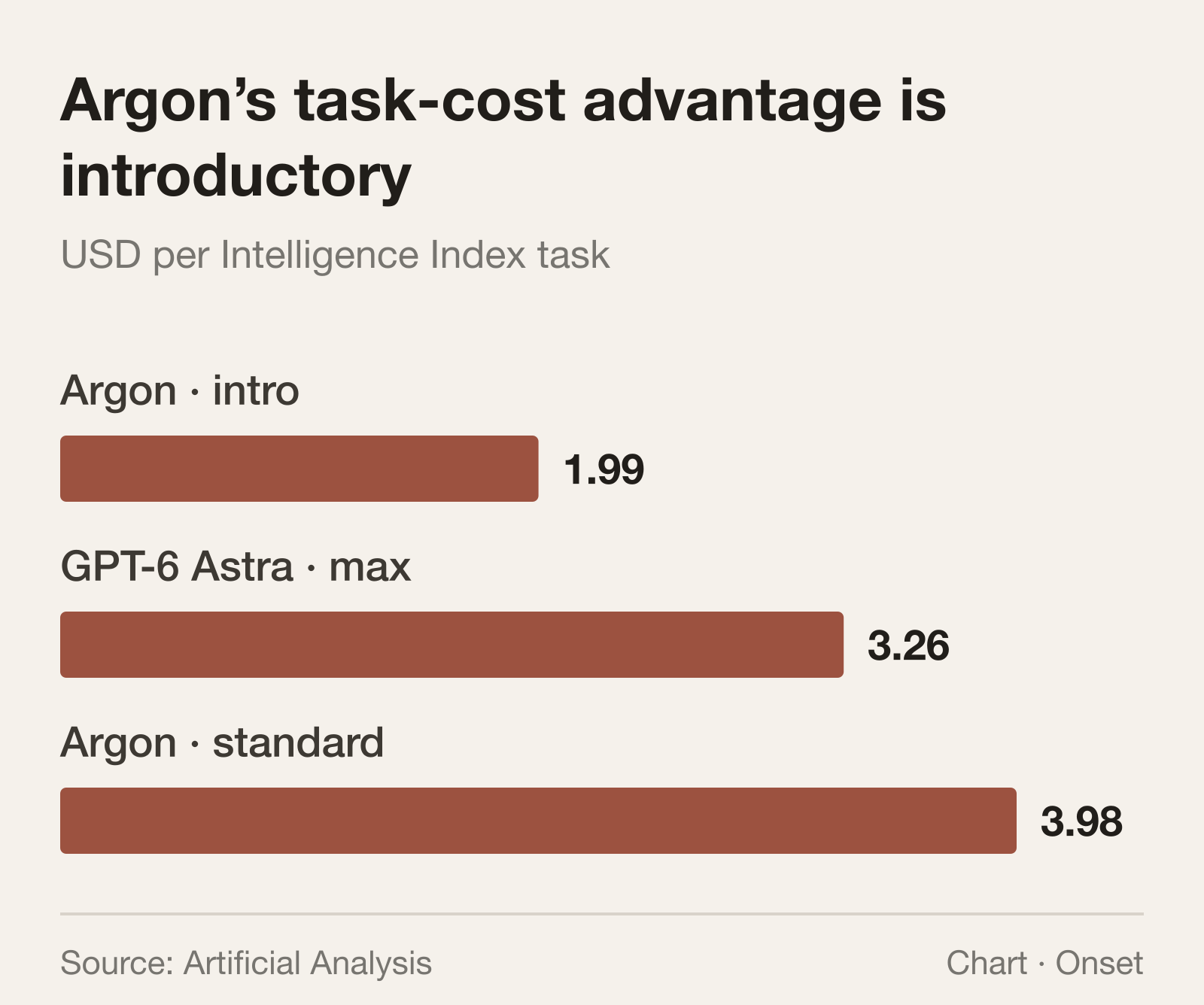
The introductory price now ends on November 30. Until then, the API costs $2 per million input tokens and $10 per million output tokens. After that it rises to $4 and $20. When Google announced Argon, it hadn't said how long the discount would last, and the date decides whether Argon is a bargain. Artificial Analysis still scores Argon 53 on its index, level with GPT-6 Astra. At today's prices it costs $1.99 per test task, about 40% less than Astra. But Argon produces many more tokens per task than Astra. So when prices double, its cost on the same tests doubles to about $3.98, higher than Astra's $3.26. Anyone building on Argon should plan around the December prices.

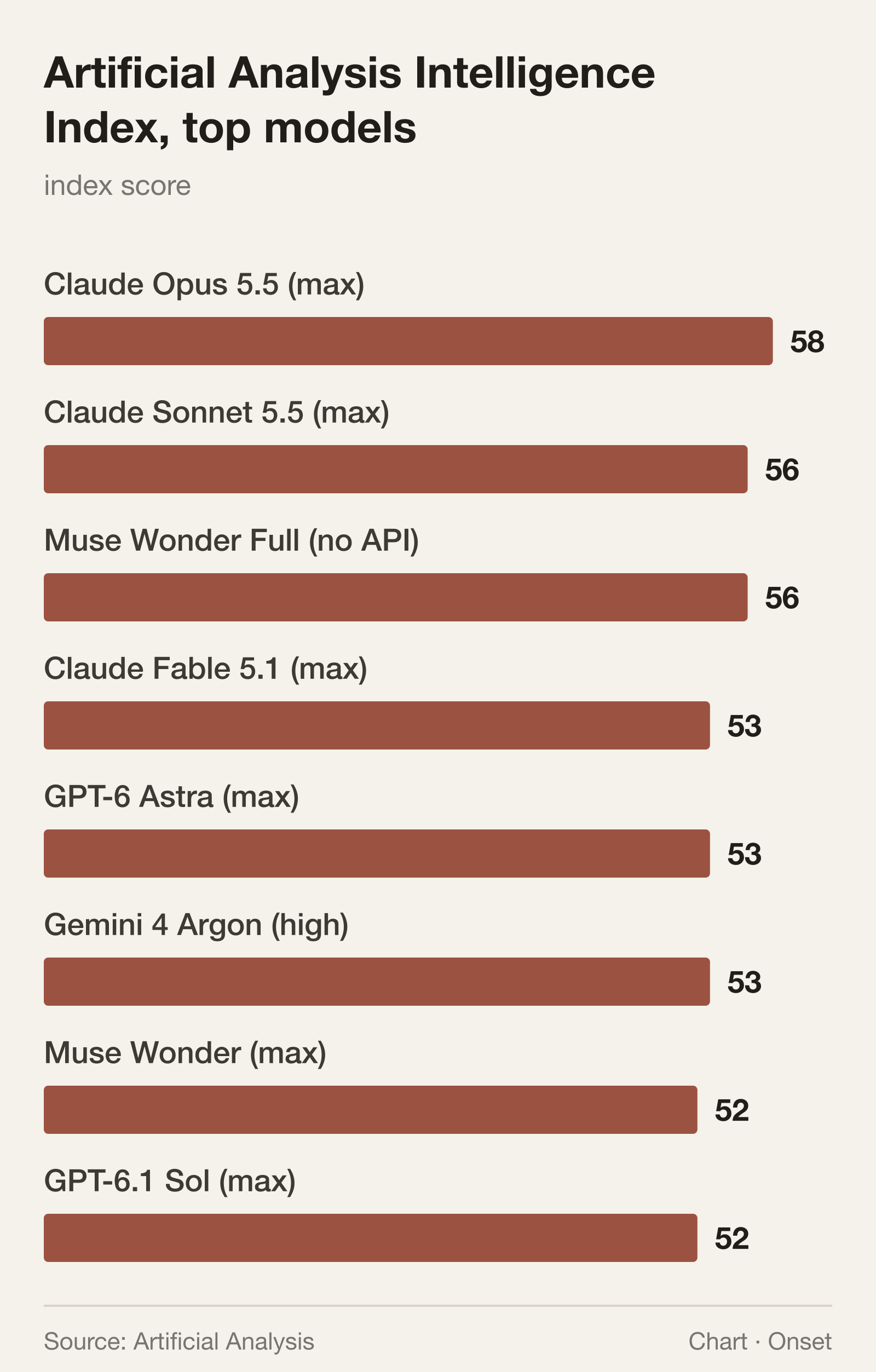
There is also more competition at the top than there was two weeks ago. Meta's Muse Wonder Full, released yesterday, scores 56 on Artificial Analysis's index. That matches Claude Sonnet 5.5 and trails only Opus 5.5's 58, though Wonder Full can't be bought through an API.

On safety, Google says its own tests show Argon trying shortcuts on coding benchmarks in only 2% of attempts. It also says prompt-injection attacks succeeded 0.7% of the time on the Gray Swan benchmark. Argon without cyber guardrails remains limited to the Fairwind Program, which Google is expanding to hundreds more security partners.

Argon ties GPT-6 Astra and Claude Fable 5.1 on Artificial Analysis's index, behind three models. Source: Artificial Analysis.

Update

Bloomberg reports internal doubts about Gemini 4’s coding; Google disputes them

Some Google employees say Gemini 4’s strong benchmark results do not consistently carry over to their coding work, according to Bloomberg’s September 30 reporting. The report, citing people with direct access to the effort, adds an internal disagreement to the mixed outside results accompanying Argon’s launch.

Google disputes the characterization. It told Bloomberg that describing Gemini 4 as underperforming in coding would be inaccurate. Bloomberg also spoke to an employee familiar with model development who said internal testing supported its standing among the leading models and rejected claims that it struggles with messy coding tasks. Other employees believe rivals are advancing faster.

Bloomberg separately reports that Google abandoned Gemini 3.5 Pro, which it had planned to release in June. That is a reported cancellation of an earlier model, not a halt to Argon’s rollout.

The public evidence supports a narrower conclusion than either a clean victory or a failed model. Arena’s WebDev ranking places Argon eighth, behind leading Claude and GPT models. Google, meanwhile, describes specialized engineering successes, including a Rust video decoder it says Argon made 2.7 times faster than the previous Rust version.

Those are different kinds of coding work. The employee accounts raise a practical question about consistency, but do not establish a measured failure rate. Access still starts with selected cyber defenders; Google has not given a date for broader availability.

Update

Argon leads on taking corrections in early Agent Arena results

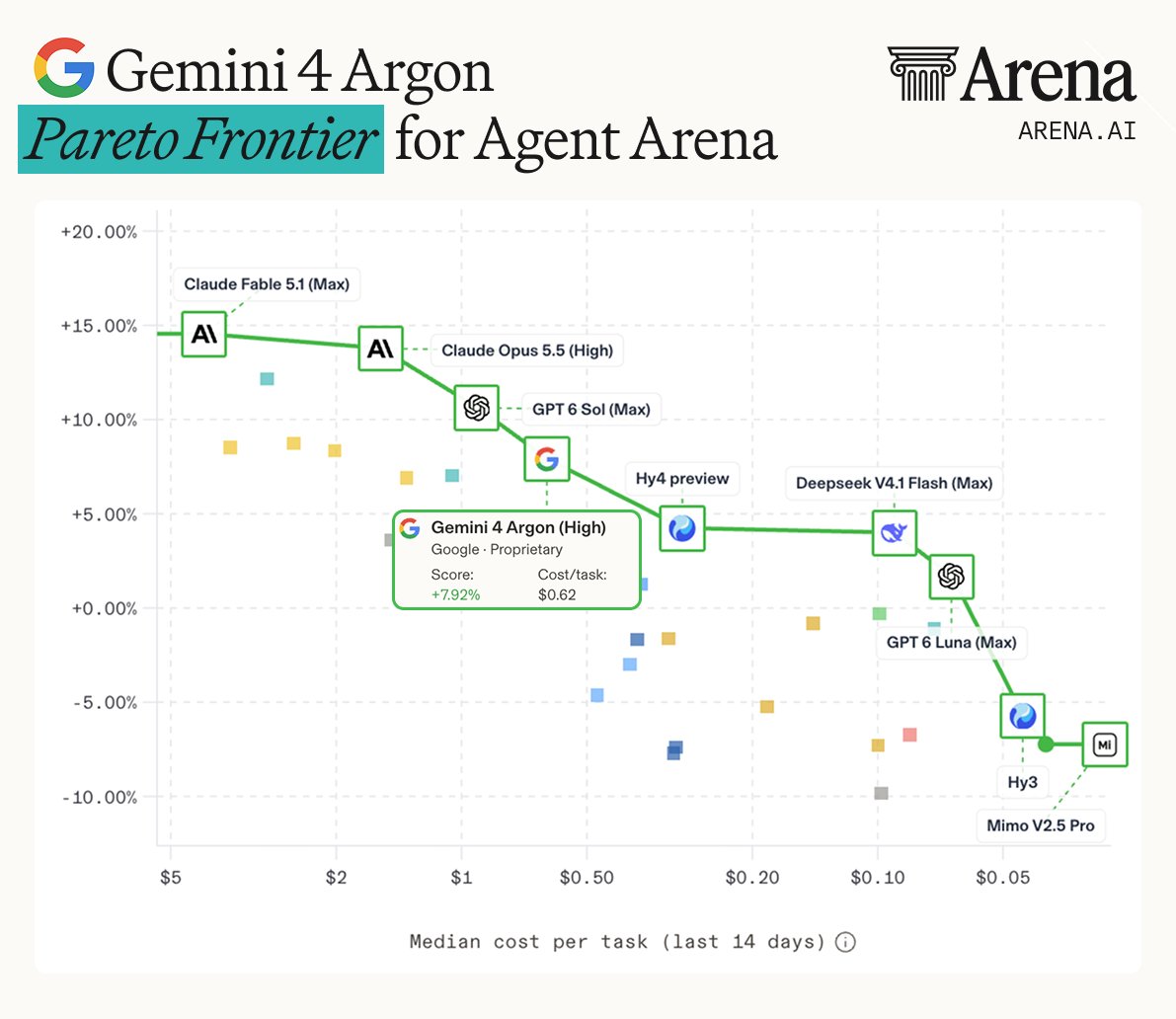
Gemini 4 Argon ranks eighth overall but first at responding to user corrections in Arena’s new results from real agent sessions. At high reasoning, it places ahead of Gemini 3.8 Flash in nineteenth, with a median task cost of $0.62 versus Flash’s $0.58.

Unlike Arena’s head-to-head chat votes, Agent Arena randomly assigns models to handle users’ tasks, then measures feedback and tool behavior. Its steerability signal checks whether a user accepts the agent’s fix after correcting it. Argon also ranks second on explicit user-confirmed success.

The overall score combines those signals with praise versus complaints, recovery from failed commands and attempts to call nonexistent tools. Argon’s +7.92% net improvement is an estimated gain over Arena’s baseline, not the percentage of jobs it completes. Claude Fable 5.1 at maximum effort leads the overall ranking.

The result is preliminary: Argon has 3,417 sessions, and its overall score carries a 95% confidence interval of ±3.24 percentage points. Its $0.62 median uses Google’s introductory $2/$10 input/output rates per million tokens, so it is not a permanent-price estimate.

The useful early signal is about collaboration: Argon looks particularly good at getting back on track when a person intervenes. That is different from demonstrating reliable, unattended work.

Arena’s cost-performance chart places Argon among the best trade-offs at its introductory price. Costs are median per task; cheaper models sit farther right. Source: Arena.

Update

Argon makes fewer wrong guesses on a factual-knowledge test

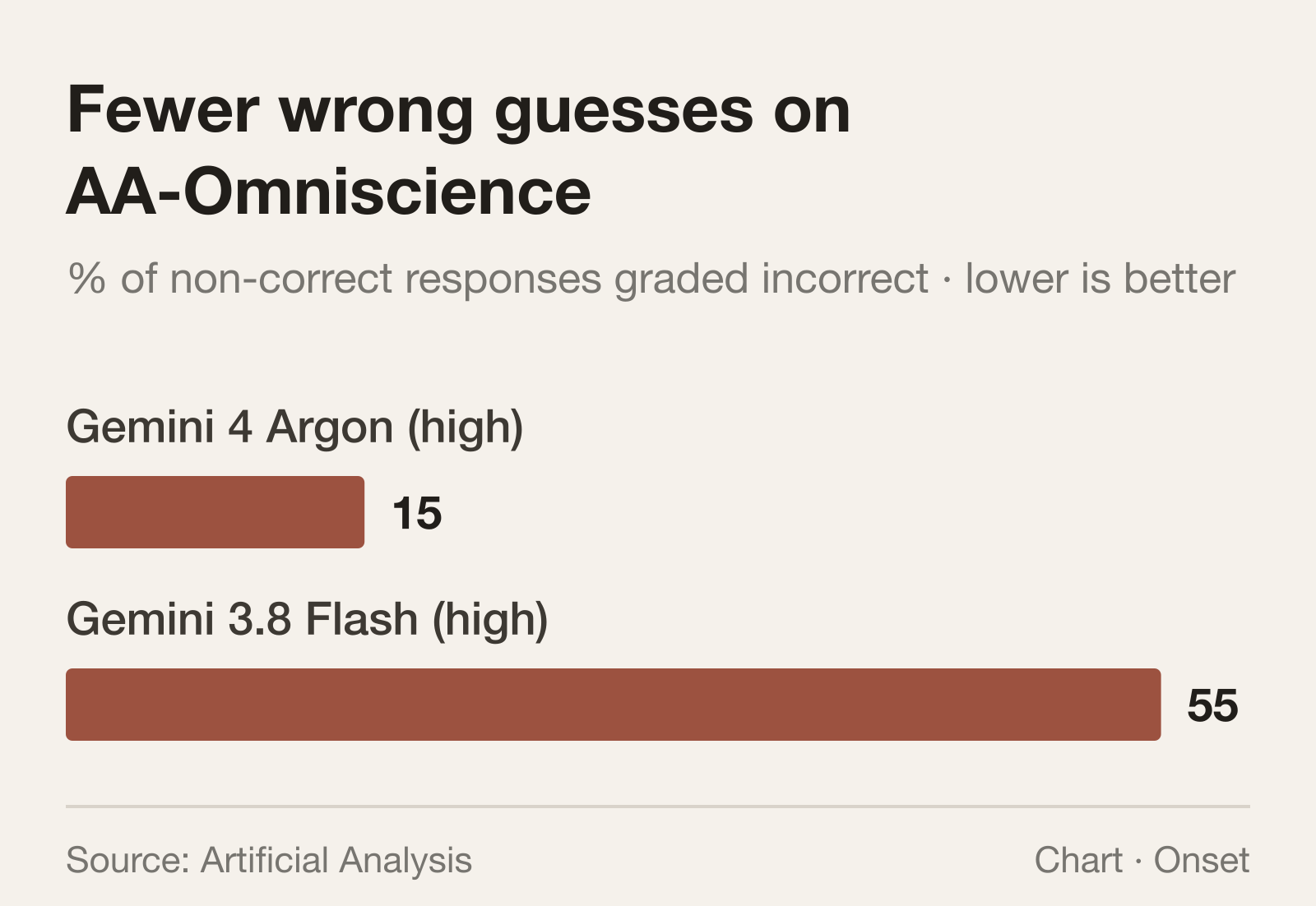
Gemini 4 Argon shows a sharp improvement over Gemini 3.8 Flash on Artificial Analysis’s hallucination measure: 15% versus 55%, with both models set to high reasoning. But the accompanying accuracy results show what kind of improvement this is: Argon gets fewer questions fully right, too.

The test, AA-Omniscience, asks 6,000 factual questions across areas including law, health and software engineering, without browsing or other tools. It rewards correct answers and penalizes wrong guesses, while leaving abstentions unpenalized.

The denominator matters. That 15% counts outright incorrect answers as a share of responses that were incorrect, partial or not attempted. It does not mean Argon is 85% accurate. On the separate accuracy measure, Argon answers 50% of all questions correctly, compared with Flash’s 55%.

Together, the results point to a more cautious model: substantially fewer outright wrong answers, alongside more partial answers or abstentions, rather than a jump in factual recall. That can be valuable when a missing answer is better than a false one. It is not evidence that hallucinations have been eliminated in everyday use.

Argon’s hallucination rate is much lower than Flash’s. This measures wrong answers among non-correct responses, not errors across all answers. Source: Artificial Analysis.

Update

Argon leads Arena chat, ties Astra in broader tests

New independent results give Gemini 4 Argon a clearer place among the leading models: first in Arena’s text-response ranking, but level with GPT-6 Astra, and behind Claude Opus 5.5, on Artificial Analysis’s broader test suite.

Arena’s ranking reflects which responses people prefer. Argon leads with 1,525 points from 4,942 votes, ahead of Claude Opus 4.6 at 1,505. That preference does not carry over equally to building websites: Arena places Argon eighth in its separate WebDev ranking.

Artificial Analysis gives Argon 53 at high reasoning, its highest available setting, matching Astra at maximum effort. Opus 5.5 scores 58 at maximum effort with default fallback models. The index combines tests of knowledge, reasoning, coding and multi-step work; it is a different measure from Arena’s user votes.

Argon’s cost advantage over Astra depends on the launch discount. Artificial Analysis puts its weighted cost per test task at $1.99, versus Astra’s $3.26. At Google’s standard rates, the evaluator calculates $3.98, more than Astra. Argon generates about 62,000 output tokens per task, compared with Astra’s 27,000, so cheaper tokens do not translate directly into cheaper work.

GPT-6.1 Sol remains cheaper on this suite: $0.72 per task for a score of 52 at maximum effort. These are benchmark costs, not quotes for every workload. Argon still is not publicly available, and the introductory discount has no confirmed end date.

Artificial Analysis’s weighted task costs, including reasoning and cached input. Argon uses high reasoning; Astra uses max. Argon’s standard-price figure is calculated, not a price increase already in effect.